
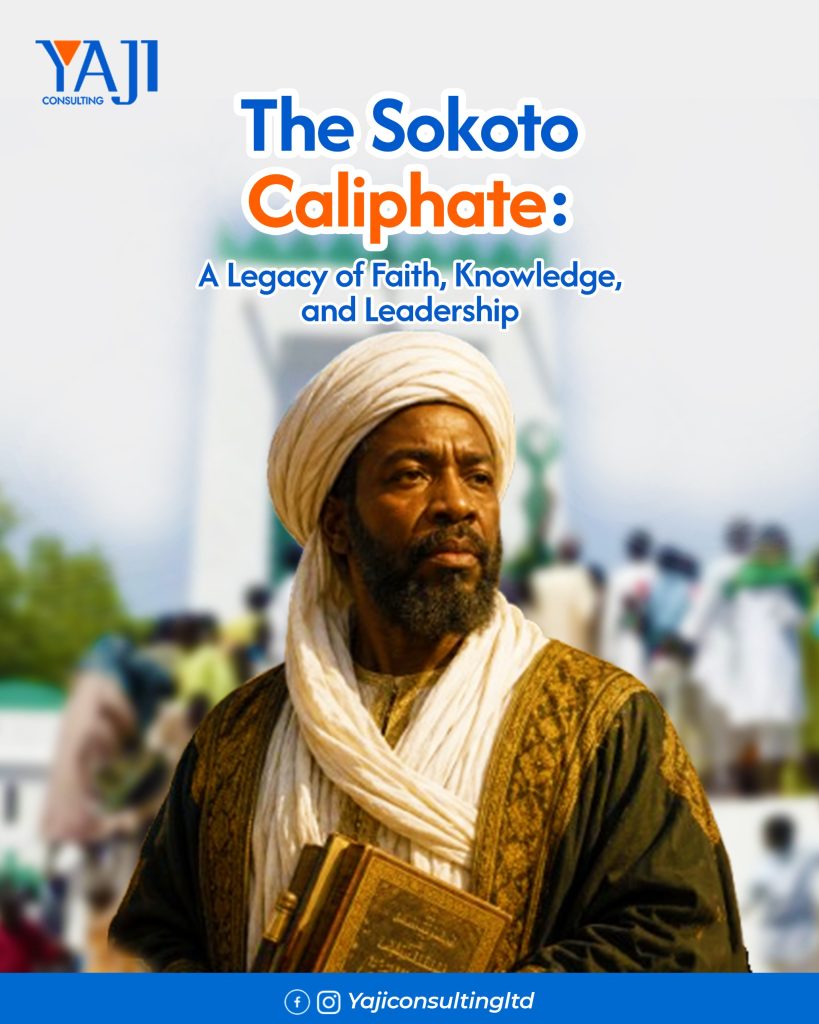
The history of Northern Nigeria is filled with remarkable civilizations that shaped politics, education, religion, and culture across West Africa. Among the most influential was the Sokoto Caliphate, a powerful Islamic empire founded in the early 19th century by Usman dan Fodio. More than a political entity, this historic empire became a center of scholarship, governance, and religious reform whose influence continues to be felt today.
At YAJI Consulting, we believe that understanding our heritage helps us appreciate the foundations of our society and inspires future generations to preserve our rich cultural identity.
What Was the Sokoto Caliphate?
The Sokoto Caliphate was established in 1804 following the Fulani Jihad led by Islamic scholar and reformer Usman dan Fodio. Initially, the movement sought to promote Islamic teachings, social justice, and ethical leadership. However, it soon evolved into one of the largest and most influential empires in West African history.
At its height, the empire stretched across much of present-day Northern Nigeria and into parts of Niger, Cameroon, and Burkina Faso. As a result, it became one of Africa’s largest pre-colonial states.
Usman dan Fodio and the Rise of the Sokoto Caliphate
Usman dan Fodio was a respected Islamic scholar, teacher, writer, and reformer. Rather than seeking power for personal gain, he advocated for religious education, moral leadership, and justice within society.
Consequently, his teachings attracted thousands of followers who supported his vision for a society built on Islamic principles. Following a series of military campaigns, the empire was established, with Sokoto serving as its capital.
His influence extended far beyond politics. In addition, he encouraged literacy, education, and intellectual development, leaving behind numerous written works that continue to be studied today.
How the Caliphate Governed Its Empire
One of the defining characteristics of the Sokoto Caliphate was its decentralized system of government.
Instead of concentrating authority in a single location, the empire was organized into several emirates. Each emir governed his territory while recognizing the spiritual and political leadership of the Sultan in Sokoto.
This structure allowed the state to administer a vast territory efficiently while preserving local leadership and customs. Furthermore, it strengthened cooperation among the different emirates under a shared vision.
Islamic Scholarship in the Sokoto Empire
Beyond governance, the empire became internationally recognized for learning and scholarship.
Islamic schools flourished throughout the region, attracting scholars from across West Africa. Moreover, education was encouraged for both men and women, with many members of Usman dan Fodio’s family contributing significantly to Islamic literature and education.
One of the most notable figures was Nana Asma’u, a renowned scholar, poet, and educator whose writings continue to inspire scholars around the world.
Therefore, the Caliphate became known not only for its political strength but also for its intellectual achievements.
Economic and Cultural Influence Across West Africa
The Sokoto Caliphate also played an important role in regional commerce.
Because it controlled key trade routes, merchants exchanged agricultural products, textiles, livestock, leather goods, and scholarly works across West Africa.
At the same time, the empire promoted cultural exchange among diverse communities, strengthening relationships through trade, education, and shared religious values.
This combination of economic activity and cultural interaction contributed significantly to the prosperity of the region.
The Fall of the Empire
Although the Sokoto Caliphate flourished for nearly a century, British colonial expansion eventually brought its political authority to an end.
In 1903, British forces captured Sokoto, marking the formal incorporation of the Caliphate into British colonial administration.
Nevertheless, its religious institutions, traditional leadership, and educational influence continued to shape Northern Nigeria long after colonial rule began.
An Enduring Legacy in Northern Nigeria
Today, the legacy of the Sokoto Caliphate remains deeply rooted in Northern Nigeria.
Its contributions to governance, education, Islamic scholarship, and traditional leadership continue to influence communities across the region. The Sultanate of Sokoto remains one of Nigeria’s most respected traditional institutions, symbolizing continuity, faith, and cultural heritage.
Above all, this historic empire reminds us of the importance of knowledge, ethical leadership, and community development.
Why This History Still Matters Today
At YAJI Consulting, we believe history is more than a record of the past—it is a guide for the future. About Us
The story of the Sokoto Caliphate demonstrates how visionary leadership, education, and shared values can transform societies. By preserving and sharing these stories, we celebrate Northern Nigeria’s rich heritage while inspiring future generations to value their cultural identity.
Conclusion: A Legacy That Lives On
The Sokoto Caliphate remains one of the greatest civilizations in African history. Through its commitment to faith, scholarship, leadership, and good governance, it left an enduring legacy that continues to shape Northern Nigeria and West Africa.
As we reflect on its achievements, we are reminded that preserving our history is essential to building a stronger future. At YAJI Consulting, we remain committed to promoting the stories, traditions, and historical landmarks that define our shared heritage. https://ich.unesco.org/en/lists